Recording Impossible Woman
Daisy Jones & the SixThe recording of “Impossible Woman” is a turning point in Daisy Jones’s work with Billy Dunne: what begins as a song she cannot make herself sing becomes the occasion for a vocal performance that surprises even her. Billy’s direction helps Daisy move beyond the effortlessness that usually defines her singing, while the finished take reveals a depth and range she had not known she possessed.
The Song and Its Assignment
Billy brought the song to the band after writing it the previous night. He described its central woman as elusive, like sand slipping through someone’s fingers, and connected her to things he could not have or do. He wrote it for Daisy’s vocal register, but expected her to sing it alone rather than as a duet with him.
Daisy questioned that choice. To her, the song seemed like something a man would more obviously sing about a woman. Karen recognized Daisy in the song’s image of a woman untouched by cold, whether high or low. That identification gives the recording a personal charge, but does not make the song easy for Daisy to perform: she still has to find a way into its sound on her own terms.
A Failed First Attempt
Daisy struggled to summon the performance Billy wanted. She looked around the room hoping someone would rescue her from the difficulty, grew angry, asked to take five, and went for a walk at Teddy Price’s suggestion. Rather than clearing her head, the walk deepened her conviction that she could not do it. She eventually got in her car and drove away.
Billy was angry because he had written the song for her to sing, though he understood why she was frustrated. He considered Daisy extraordinarily talented, but saw a problem in how she accessed that talent: she could not reliably call it up on command. His assessment captures the difference between having a gift and controlling it. The first attempt did not resolve that tension; Daisy left the session without completing the performance.
Billy’s Direction and the Breakthrough
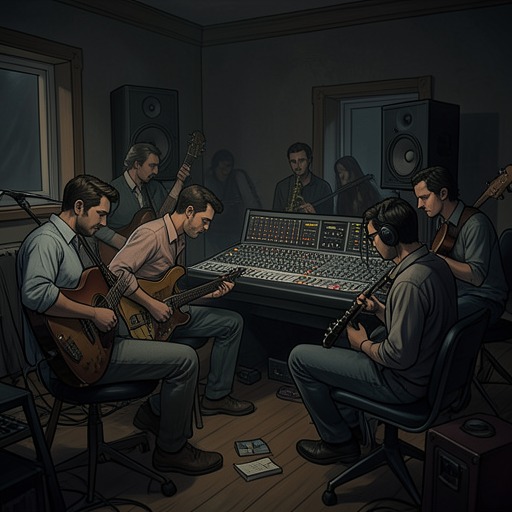
Billy asked Daisy to return the next day and promise to try again. She agreed. When she arrived, the room had been cleared of the rest of the band; Billy, Teddy, Rod Reyes, and Artie Snyder were at the session. Rod stepped out to smoke while Billy brought Daisy into the booth and encouraged her.
Billy eventually understood that asking Daisy to sing with her usual ease was the wrong approach. He wanted the song to sound as if singing it hurt, and for the performance to demand sustained effort. Daisy recognized that this was not her familiar kind of grit. Billy’s instruction was to let the voice crack and lose control rather than restrain it. The change was not simply a matter of increasing volume: he was asking her to accept roughness and exertion as part of the performance.
After several takes, Billy asked her to go an octave deeper. Rod remembered the decisive performance as either the fourth or fifth take, but thought it was probably the fifth; he identified the fifth take as the complete version used on the record. That distinction matters to the event’s shape: the breakthrough did not arrive as an abstract realization alone, but as a particular take captured in the booth.
Daisy’s singing begins assuredly, then gathers intensity gradually. Rod recalled her watching Billy as she sang, while he watched and nodded along. When she finished, Teddy applauded. Daisy opened her eyes with little memory of having performed the take, but with the immediate realization that she had done it. More than that, she understood that she had more power, depth, and range than she had previously imagined.
The Take’s Aftermath and Significance
Daisy’s delight at the performance was visible in her reaction: she pulled off her headphones, threw them down, ran out of the booth, and into Billy’s arms. He lifted her briefly from the floor and swung her back and forth. Rod thought he might have smelled her hair before setting her down, but that detail is his impression, not an independently confirmed account. The gesture registers the closeness of the moment without settling what that closeness meant beyond the recording itself.
The event’s significance lies in the change between Daisy’s departure and her return. In the first session, frustration convinces her that she cannot continue; in the second, a specific adjustment in approach lets her access a performance she had not known was available to her. Billy’s coaching matters, but the achievement is Daisy’s: she supplies the take, and the record preserves it. In the book’s oral-history form, the scene is assembled through participants’ recollections rather than a single detached account, making the breakthrough both a studio event and a story about how artistic capacity can exceed a singer’s prior sense of herself.